Posted on

New Miniatures: Short 184 Seaplanes

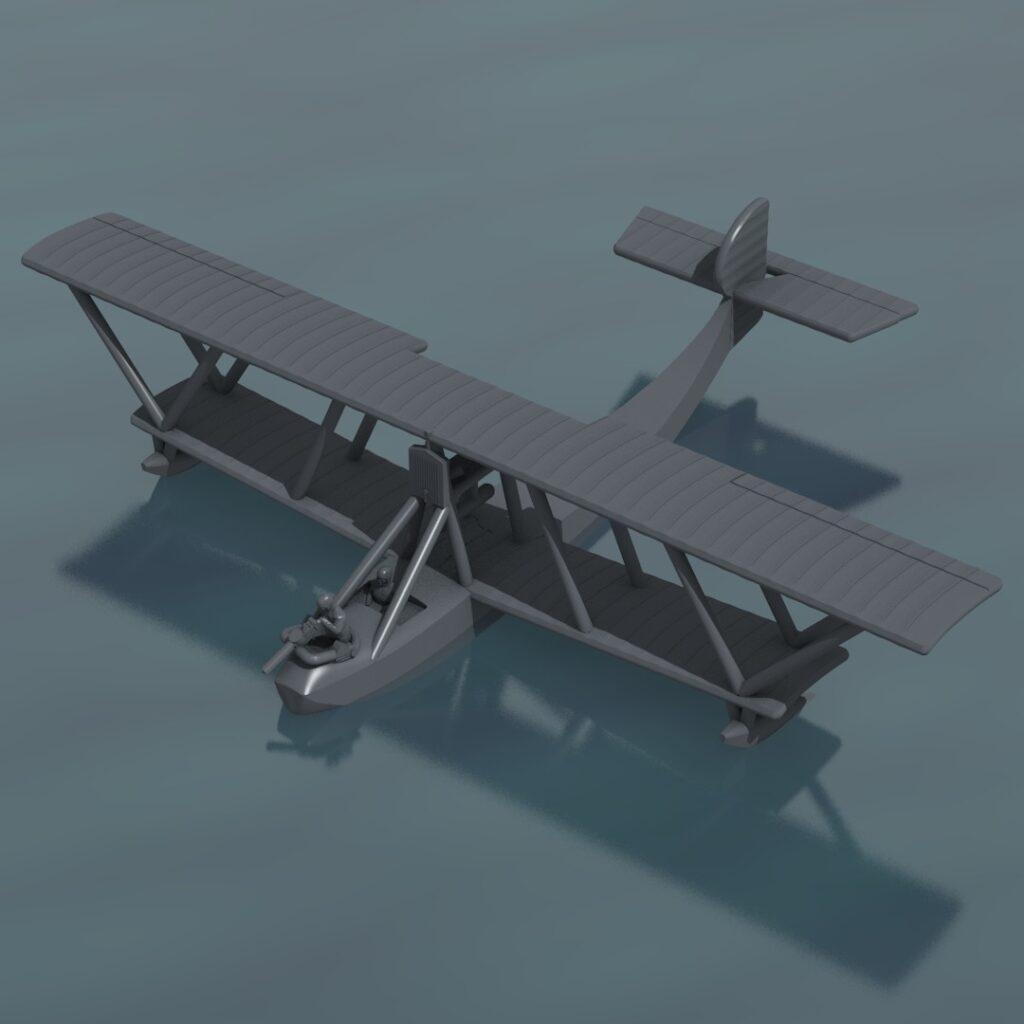
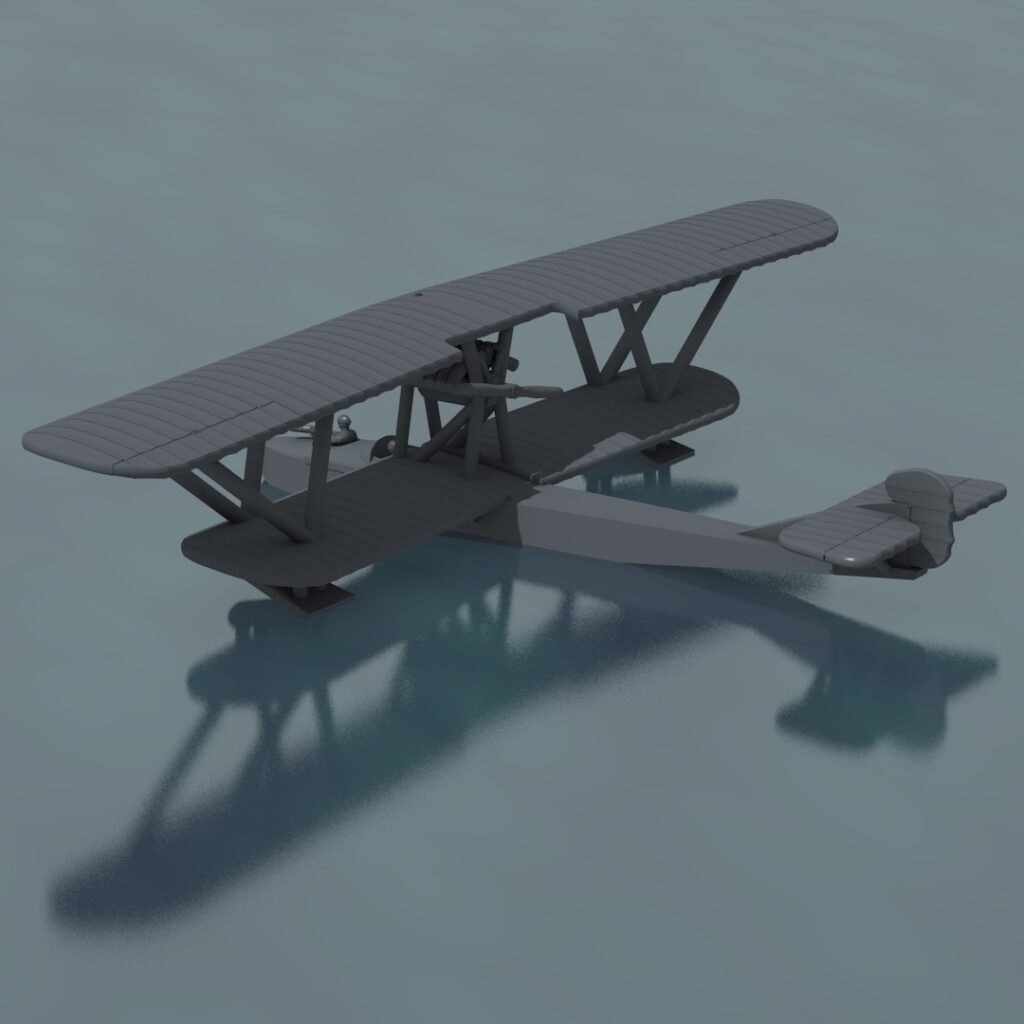
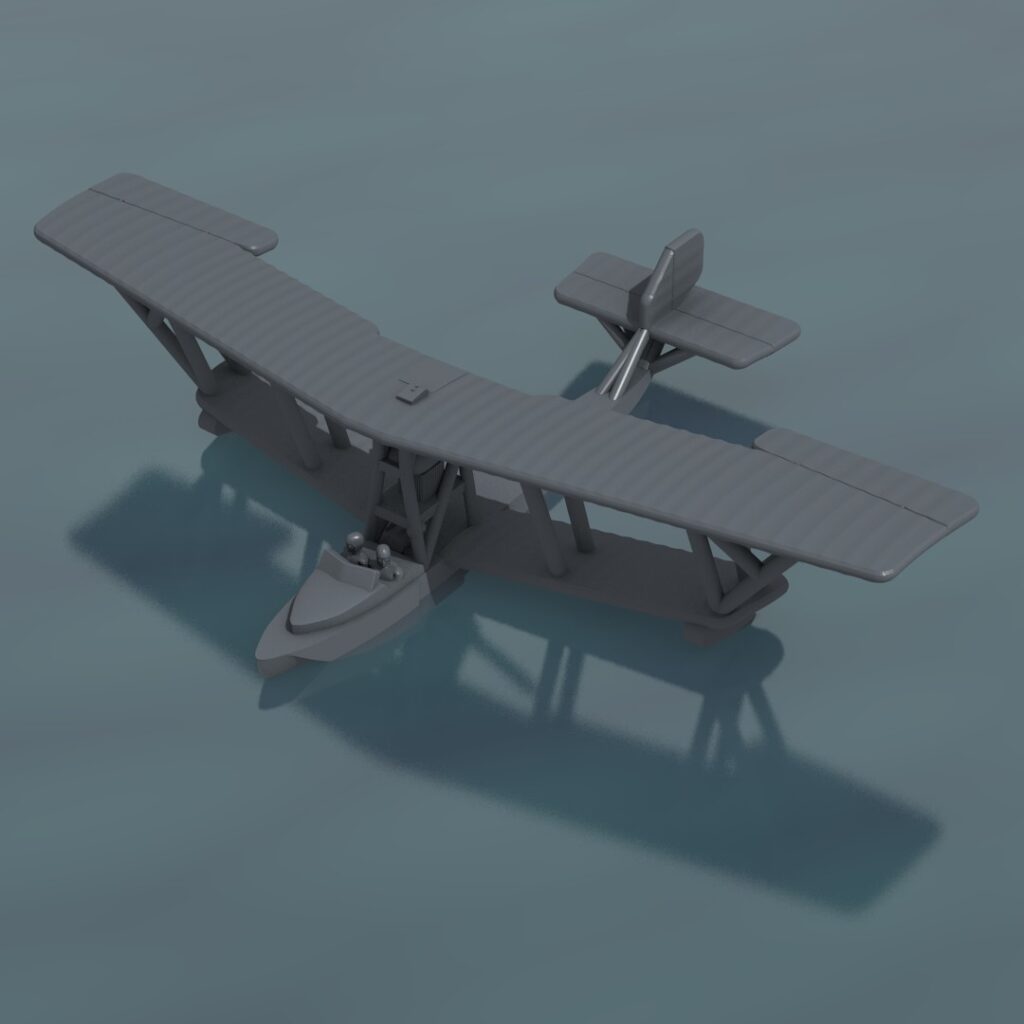
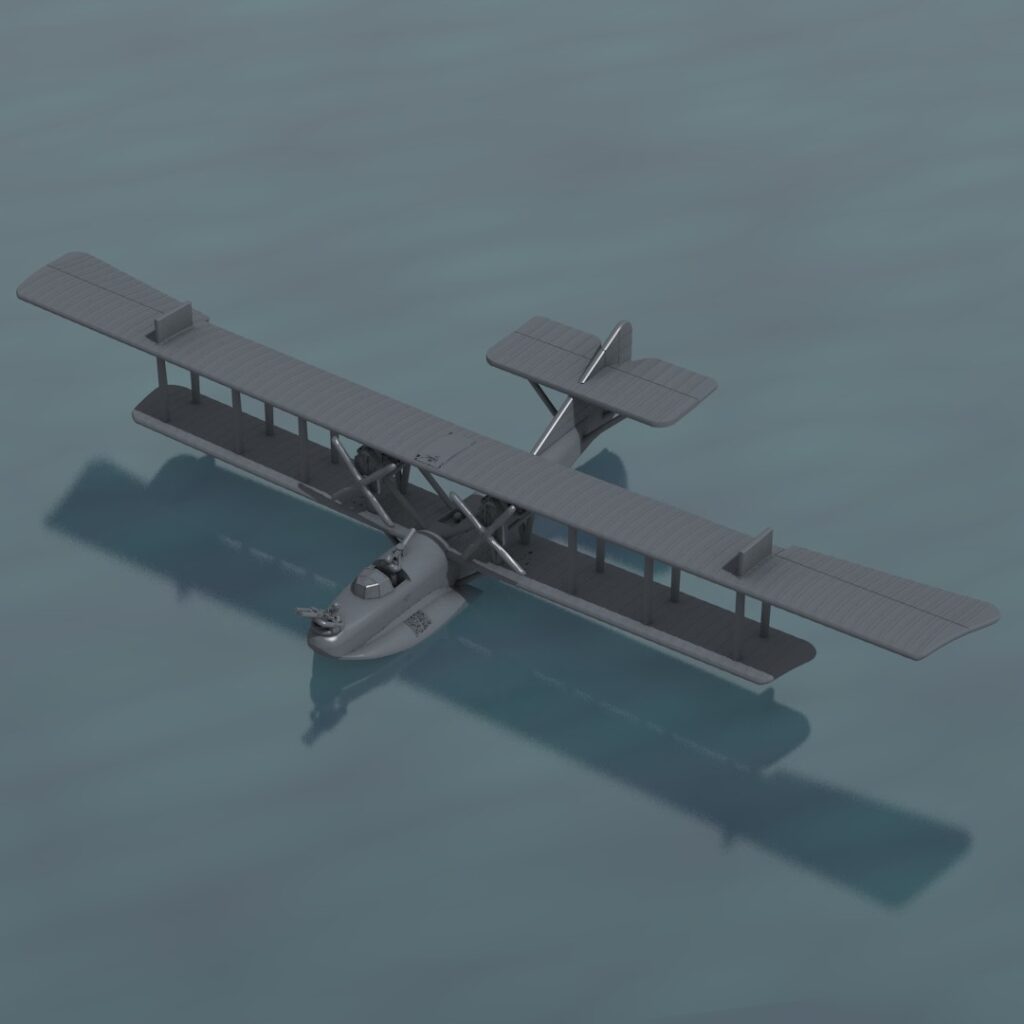
The Short Seaplane, Admiralty Type 184 was designed to carry a torpedo. Long folding wings and the characteristic large fin of the Short seaplanes make it quickly recognizable. In the Dardanelles campaign, it became the first plane to sink an enemy ship with a torpedo when a Short 184 attacked a Turkish steamer on 12 June 1915. The weight of a torpedo, however, severely limited the plane’s range and operating conditions. More often the Type 184 ran patrol, bombing, and even anti-Zeppelin missions, including the Battle of Jutland. While most served in the North Sea and from seaplane-carriers, a few were sent to Mesopotamia in February 1916. As the war progressed, the original 225hp Sunbeam engine was replaced with more powerful Sunbeams and Renaults.

While Short Bros. produced many 184’s, a large number were subcontracted to other firms, including Mann Egerton, Phœnix Dynamo, Sage, Saunders, and Westland. They were still in production at the end of the war, but they were starting to be phased out by Fairey Campanias, Fairey IIIBs, and other types. During its long service life there were many experiments with alternative engines, wing adjustments, float shapes, and armament.

Their missions ran from anti-submarine patrols (especially as the war progressed) to bombing, patrol, and torpedo attack. Though underpowered for its size, the 184 served faithfully from the beginning of the war through the end and beyond, fighting in the Russian Civil War in 1919-1920. Some were taken by the Russians after they were abandoned by the British, and eight were given to Estonia, five to Chile, five to Greece, and one to Japan.

Two 1:144 Short 184 miniatures are now available from Great War Planes by Reduced Aircraft Factory: one with a loaded bomb rack and one carrying a torpedo.
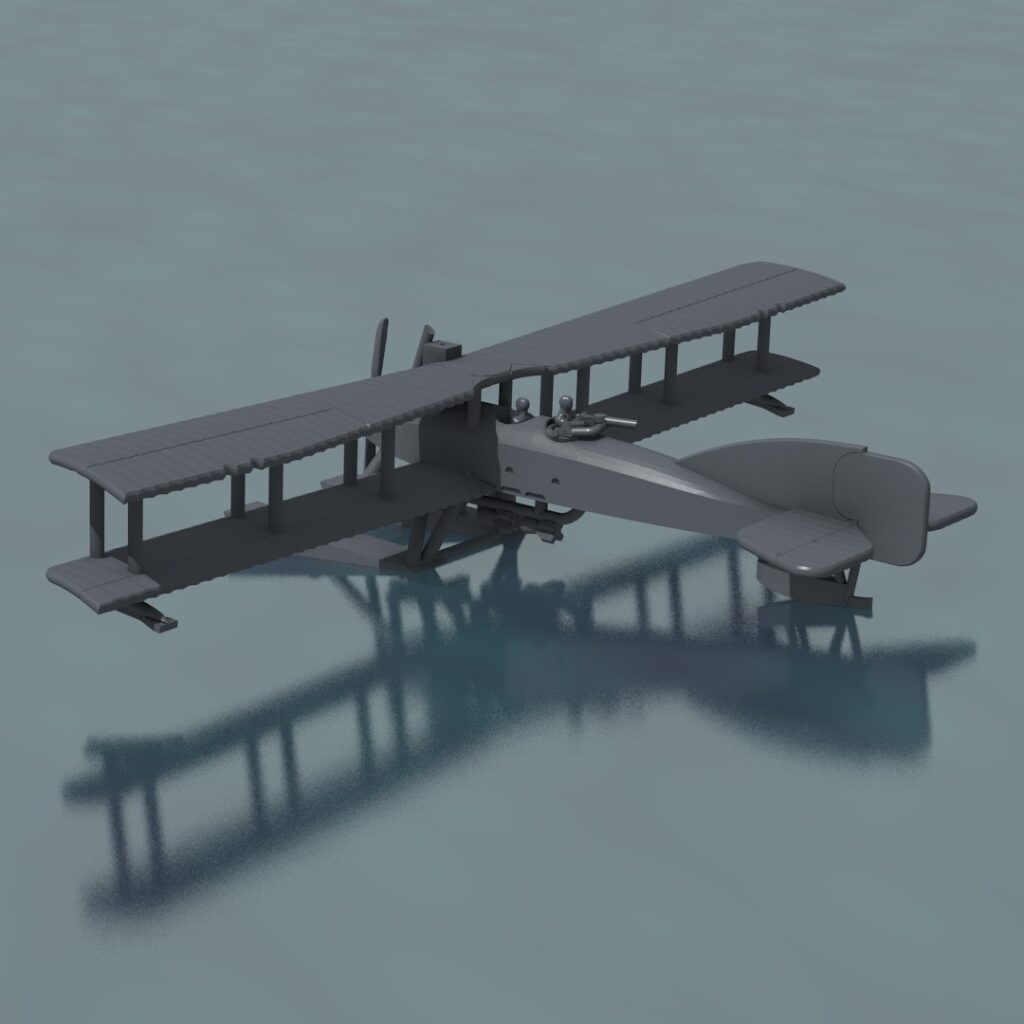
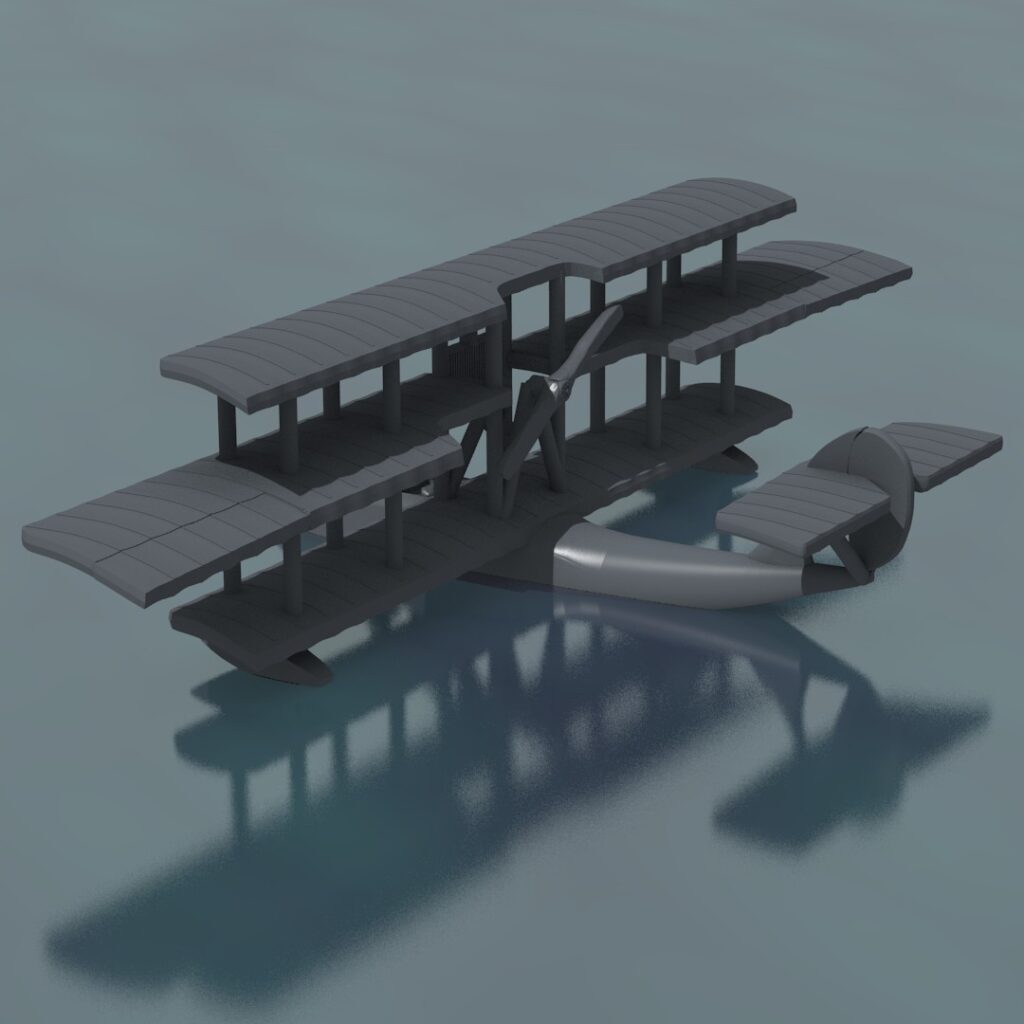
Computer render
Computer render
Posted on

New Miniature: Levy-Besson “Alerte” Flying Boat

The Alerte class of triplane flying-boat was intended for long patrols and carried a radio and small bomb loaded, with the intent of spotting enemy planes, seaplanes, and submarines and radioing for help when needed. Levy-Besson’s entry for this class was based on a triplane fighter.

One hundred Levy-Besson Alerte Flying Boats were built and used by Aviation Maritime, entering service in October 1917. It was used primarily in the anti-submarine role. Production of triplane flying boats was relatively limited because they were harder maneuver on water.

A paintable 1:144 miniature of the Levy-Besson “Alerte” Flying Boat is now available from Great War Planes by Reduced Aircraft Factory.

Computer render
Computer render
Posted on

New Miniatures: The Tellier T.3 and T.6

Naval aircraft month continues with the release of these French flying boats, the Tellier T.3 and T.6. The T.3 was also used by the U.S. Navy.

In WWI the French were great proponents of flying boats, and the Tellier T.3 served with distinction alongside flying boats from F.B.A., Donnet-Denhaut, and Levy-Besson. Tellier was already accomplished at building boats before the war, and the Tellier flying boats had the reputation of having the best hull of any flying boat. About 190 were built and from February 1917 through the end of the war they were used for anti-submarine and mine patrols.

The USA inherited at least 32 T.3’s, which they operated from Le Croisic Naval Station starting in November 1917. Russia, via Dux, had plans to build at least twenty, but the hulls and wings were still in storage awaiting the arrival of engines when Russia exited the war. The RNAS acquired two for evaluation but there was never a production order.

In an effort to provide a cannon-armed flying boat, the Tellier T.3 was re-armed with a 47mm Hotchkiss cannon. To balance the weight of the gun, the hull was lengthened by almost a meter. The Tellier T.6 premiered in late 1917, where they were useful for patrol and convoy escort. At least fifty-five T.6s were built for Aviation Maritime.

Great War Planes by Reduced Aircraft Factory has released two new 1:144 flying boat miniatures: the Tellier T.3 and T.6.

Computer render
Computer render
Posted on

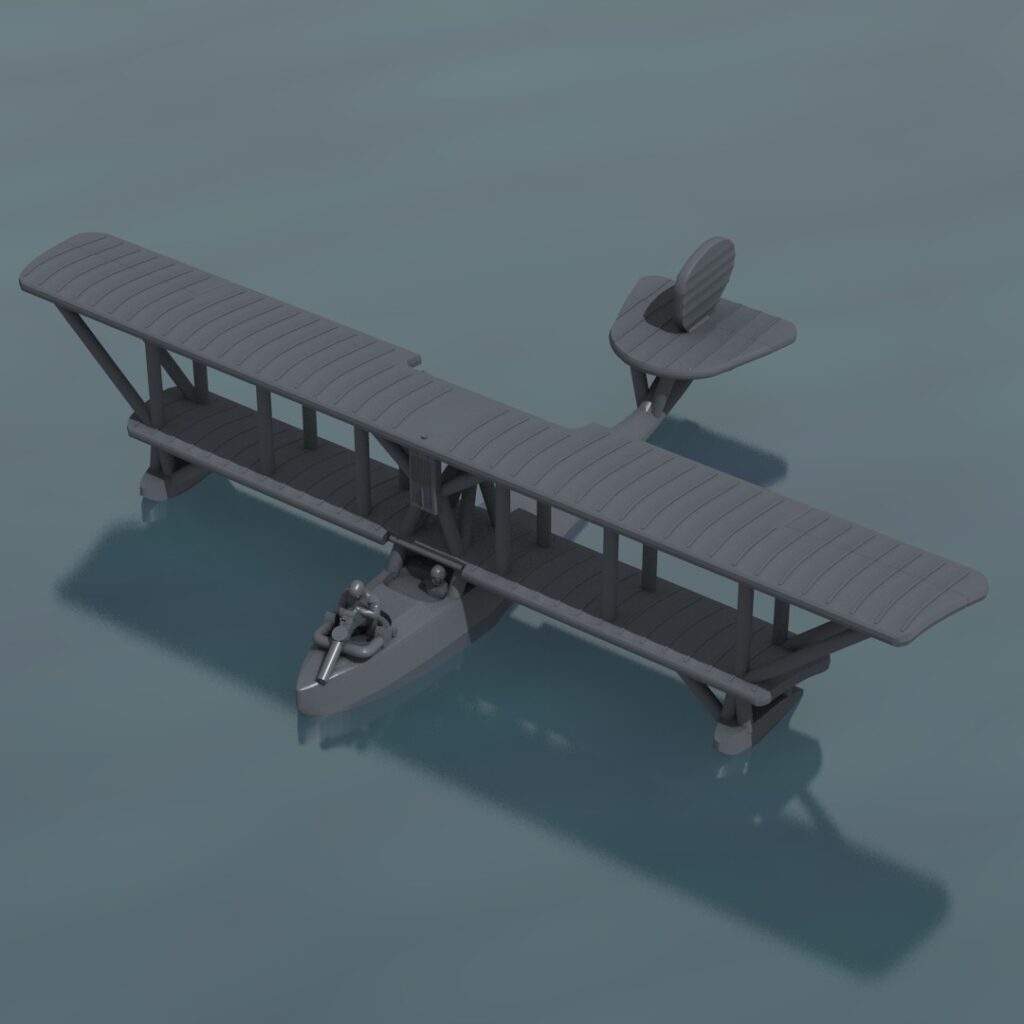
New Miniature: The Hansa-Brandenburg W.13

Though it was designed in late 1916, it wasn’t until July 1917 through March 1918 that the Hansa-Brandenburg W.13 was delivered to KuK Kriegsmarine. Shortages of the Type 21000 Daimler engine led to planes being delivered without engines, where they sat in storage until engines could be procured. Like the ubiquitous Brandenburg C.I, the W.13 was delivered by its parent company and by UFAG and Phönix, with the last of these arriving in mid-1918. Around 130 W.13’s were built overall.

The powerful 350hp V-12 engine gave the W.13 good bomb-carrying capacity, and it was used on bombing missions starting in August of 1917 over both land and sea. Its long range gave it distinct advantages in the reconnaissance and patrol roles.

A paintable 1:144-scale Hansa-Brandenburg W.13 is now available from Great War Planes by Reduced Aircraft Factory.

Computer render
Computer render
Posted on

New Miniature: The Lohner Type M Flying Boat

The Lohner Type M was an Austro-Hungarian flying boat similar to the Lohner L. The first five were delivered by May 1914 and a subsequent order of six improved M2 (Mn) flying boats were delivered by October. Two somewhat larger Mk models were tested in early 1915 for the reconnaissance role. The last two Type Ms, the “MkN”, were designed as mine-spotting aircraft, a role for which a larger aircraft was better suited, so they were relegated to training.

Type Ms were quite busy in the Adriatic in 1914 and early 1915. By spring the larger Lohner L started to take the brunt of the work and the Type Ms were moved to second-line missions, but they continued service until the last, M31, was retired in early 1917.

A paintable 1:144 3D-printed miniature for the Lohner Type M flying boat is now available at Great War Planes by Reduced Aircraft Factory.

Computer render
Computer render
Posted on

New Miniature: The Curtiss H-12 “Large America”

The history of the Curtiss H-8, which led to the Curtiss H-12, is somewhat muddled. But it is clear that the first of the new larger flying boats as successors to the Curtiss H-4 were named the H-8 by the British. The first remained in its original configuration with twin 160hp Curtiss engines; the rest were the order of fifty were refitted with 250hp Rolls-Royce engines and re-designated the H-12.

The fifty Curtiss H-12 “Large America” were ordered in Britain and began arriving for Royal Navy Air Service use in March 1916. The new engines increased the plane’s capabilities remarkably.  There is some confusion over the difference between H-12s, H-12Bs, and H-16s. After the initial batch with the 250hp engine, another twenty-four were upgraded with the 375hp Rolls-Royce and were designated the H-12B, and a further fifteen were ordered as H-12s without engines, delivered as H-16s, and fitted with the 375hp Rolls-Royce. Other sources, rather than equating the H-16 with re-engined H-12s, designate the H-16 as a larger airplane using the 400hp Liberty. Most likely some fifteen H-12s were converted to H-16s while most H-16s were built from scratch.

Lessons learned from flying the H.12s led to the excellent Felixstowe F.2, with a stronger hull and improved hydrodynamics.

Perhaps the H-12’s finest moments were on 14 May 1917 when a RNAS Curtiss shot down the Zeppelin L22 and on 14 June 1917 when L43 was shot down by another. H-12s operated widely and had frequent encounters with German seaplanes and submarines.

The US Navy experimented with H-12s (including some with Liberty engines), but the type was not used internationally. Curtiss HS.1L’s filled that role instead.

A paintable 1:144 Curtiss H-12 is now available from Great War Planes by Reduced Aircraft Factory.

Computer render
Computer render
Posted on

New Miniature: The F.B.A. Type H

Hydravions Franco-British Aviation (F.B.A.) built several flying boats during WWI, and the F.B.A. Type H was the most numerous. In fact, it may have been the most numerous flying boat of the entire war, with 982 built in Italy and several hundred in France. It was a development of the Type B airframe, but a 150hp Hispano-Suiza vee engine was used for increased power. The wings were redesigned and about half a meter wider, the tailplane was altered, and the hull was strengthened. A crew of three was carried: two flight personnel and a nose gunner. They were also used in small numbers by Belgium, Spain, the U.K., and the U.S.A.

In Italy, at least 982 were built: 38 in 1916; 367 in 1917; and 477 in 1918. A handful of Italian Type H’s were shifted to the RNAS at Otranto. A full 28 squadriglias used the Type H, mostly supplied under license by SIAI (Societa Idrovolanti Alta Italia). These latter machines used a 170hp Isotta-Fraschini engine. SIAI could not keep up with the demand and spread production over six subcontractors. The Type Hs were used all along the Italian coast and by war’s end there were still 382 in service.

A paintable 1:144 -scale F.B.A. Type H is now available from Great War Planes by Reduced Aircraft Factory.

Computer render
Computer render
Posted on

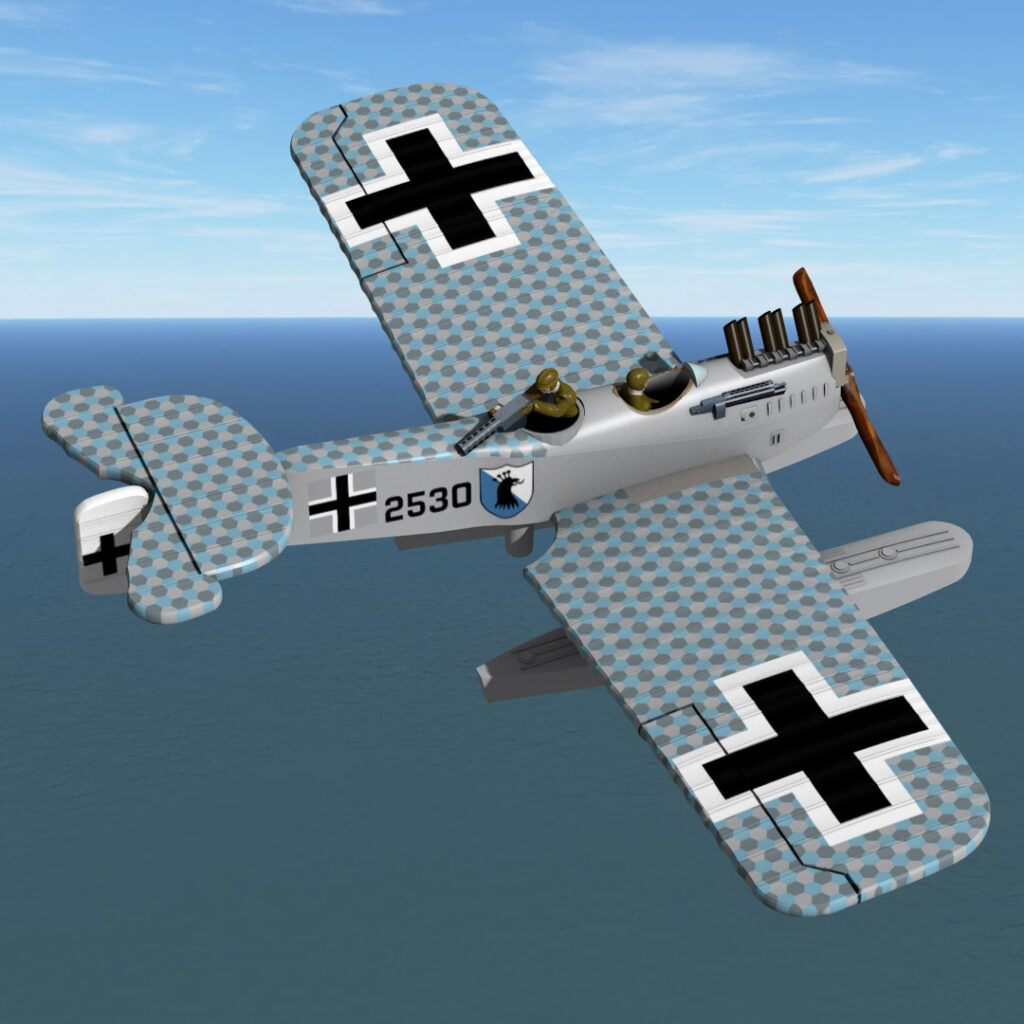
New Miniatures: The Hansa-Brandenburg W.29

The Hansa-Brandenburg W.29 was an innovative monoplane developed from the W.12. It retained and improved on the maneuverability of the W.12, but it was still limited in range and sometimes relied on the Hansa-Brandenburg W.19 to scout out targets. W.29’s were known to take on even Sopwith Camels, as a battle of 18 July 1918 demonstrated.

About three-quarters of W.29’s built were armed with two forward-firing machine guns (156 of 199), aka the C3MG. The rest substituted a radio for the second fixed machine gun, and they were known as the C2MGHFT. The 150hp Benz Bz.III was the most common engine, but the 185hp Benz Bz.IIIa and 170hp BMW.IIIa were also used in smaller numbers, but their supply may have been limited by the high demand for those engines in other aircraft.

It operated with great success, especially out of the base at Zeebrügge. Twenty-five W.29’s were dispatched to Turkey, but it is uncertain whether they ever arrived and whether they were used by German or Turkish pilots (if anyone). Austria-Hungary ordered twenty-five from UFAG, but only one was delivered before the Armistice, taking its first flight on 25 Oct 1918.

Two paintable and three full-color Hansa-Brandenburg W.29 miniatures are now available at Great War Planes by Reduced Aircraft Factory.

Computer render
Computer render
Posted on

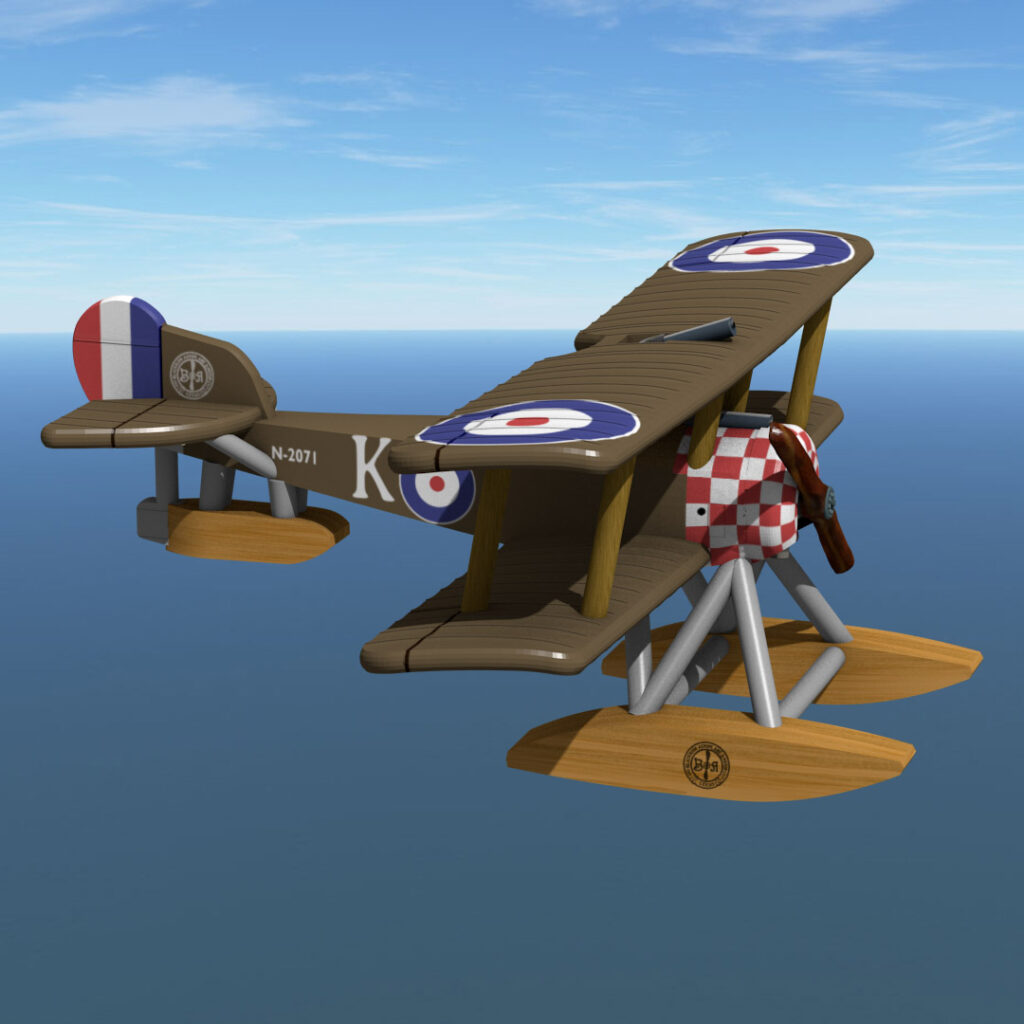
New Miniatures: The Sopwith and Ansaldo Baby

The Sopwith Baby was a Sopwith Schneider mounting the 110hp Clerget engine (and later the 130hp model). The change of the engine also forced a change from the pointed nose of the Schneider to a horseshoe cowling. While early Babys used the same gun mount as the Schneider: a top-wing Lewis angled upward to clear the propeller, later Babys used a synchronized Lewis that made for easier aiming.

Like the Schneider, the Baby performed a variety of missions from naval bases and from seaplane carriers in most theatres of the war. Fifty-eight to eighty were still on charge near the end of the war, giving this plane one of the longest service lifetimes of the war.

Ansaldo built a copy of the Baby under license, but by the time they were finished, the Ansaldo Babys were feeling their age, and they only saw limited action outside of training.

Five full-color and two paintable Sopwith or Ansaldo Baby 1:144 aircraft miniatures are now available from https://greatwarplanes.com.

Computer render
Computer render
Posted on

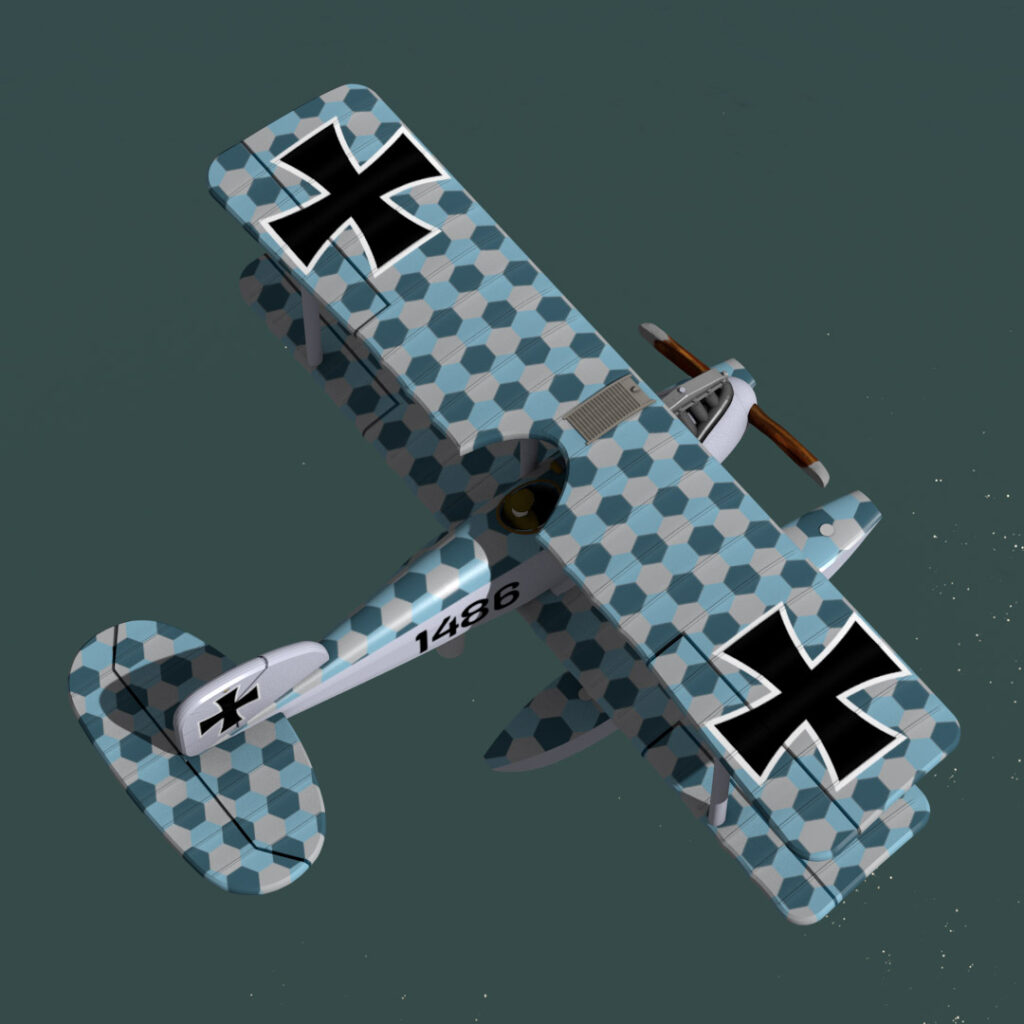
New Miniatures: The Albatros W.4

As a response to the rising threat of Entente flying boats, the German navy developed several Jagdeinsitzer Wasser (Seaplane fighting scouts) in 1916, including the Albatros W.4. Though it was derived from the Albatros D.I, many details were changed (beyond the obvious addition of floats), such as a wider wingspan and wider gap. Various types of floats were tried as production ran along, and 118 were built before they were supplanted by Brandenburg types.

The first W.4 was delivered in September 1916, but initial production was slow, with the first ten arriving in Feb-April 1917. Eventually 118 would be delivered, some with an offset wing radiator rather than ear radiators, and some with four-wing ailerons. They served mostly on the Flanders coast, but some were seen over the Aegean.

Two paintable and three full-color 1:144 Albatros W.4 miniatures are now available from Great War Planes by Reduced Aircraft Factory.

Computer render
Computer render